
Fractional CFO: Meaning, Services, Cost, and When to Hire
A fractional CFO is an experienced chief financial officer who works with your company part-time, usually on a monthly retainer, instead of as a full-time employee. The word “fractional” describes the slice of the week you buy. You get a senior executive’s forecasting, strategy, and fundraising judgment for a share of the hours and a fraction of the salary. People also call the role a part-time CFO or an outsourced CFO, and the people who do the work are often called fractional CFO consultants.
That definition leaves out what matters to an owner: whether you need one, what you would actually get, and what it costs. This article covers why the model exists, what a fractional CFO does week to week, current market pricing with a worked example, and how to hire one without paying for hours that produce nothing.
At FlowStates Financial, our CPA-led team runs fractional CFO engagements alongside bookkeeping and payroll for U.S. small and mid-sized businesses. The practical advice below reflects how those engagements work in practice.
Why a fractional CFO matters for a growing business
A fractional CFO matters because the decisions that need CFO-level judgment, such as pricing, hiring, and fundraising, arrive years before a company can justify a CFO-level salary. A full-time CFO commonly costs $200,000 to $400,000 a year, and many businesses in the $1 million to $10 million revenue range cannot keep that role busy enough to earn it back.
How a fractional CFO differs from other finance roles
The finance roles overlap in conversation but not in the work. This table shows where each one fits.
| Role | Commitment | Main job | Best fit |
|---|---|---|---|
| Bookkeeper | Ongoing | Records transactions, reconciles accounts | Accurate, current books |
| Controller | Ongoing | Closes the books, runs controls, produces reports | Reliable reporting |
| Fractional CFO | Part-time, ongoing | Forecasting, strategy, fundraising, KPIs | CFO decisions without a full-time seat |
| Interim CFO | Temporary, often full-time | Holds the seat during a transition | A CFO just left |
| Full-time CFO | Full-time, permanent | Owns all finance strategy and the finance team | Complex, larger organizations |
The line people blur most is the one between the controller and the CFO. Bookkeepers and controllers look backward, recording what happened and closing the period. A CFO looks forward, using those numbers to decide what you should do next quarter.
A bookkeeper tells you what happened, and a fractional CFO helps you decide what to do next.
Signs it is time to hire one
You do not need a CFO because you are busy. You need one when a specific decision is costing you money or sleep. These are the triggers I see most often:
- You are preparing to raise capital and need an investor-ready model.
- Cash surprises you, and you cannot say how many weeks of runway you have.
- Revenue is growing but margins are shrinking.
- Hiring and pricing decisions rest on gut feel.
- Spreadsheets or a basic QuickBooks setup no longer match how the business runs.
- An audit, acquisition, or sale is on the horizon.
Wait if your books are still weeks behind. A CFO working from unreliable numbers produces unreliable forecasts, so fix the bookkeeping first, or buy both together so the same team owns the data and the analysis.
What a fractional CFO does week to week
A fractional CFO owns your financial strategy and the systems behind it, turning your numbers into decisions about cash, hiring, pricing, and capital. Engagements come in two styles. Advisory fractional CFO consulting means a regular strategy session and monthly review. An embedded engagement means the CFO joins leadership meetings and directs the finance team. Either way, the services fall into three areas.
Planning, forecasting, and cash flow
This is the core of the role. The CFO builds the budget, maintains a rolling forecast, and sets up a 13-week cash flow forecast that shows your runway week by week instead of month by month. From there they model decisions before you make them, such as whether you can afford two hires in the next quarter or what a price increase does to churn and margin.

Our own fractional CFO service includes 13-week cash flow forecasting and custom real-time KPI dashboards connected to your existing stack. The point of both is the same. You should never have to wonder where cash stands before a decision.
Fundraising, M&A, and audit readiness
When you raise money, a fractional CFO builds the financial model, assembles the data room, and answers diligence questions with you. The same skills apply to acquisitions, sales, and annual audits. They check valuation assumptions, find liabilities, and organize the audit-ready records a buyer or auditor will ask for.

Start this work well before the deal. Investors and buyers look for consistent numbers, and a CFO can fix gaps in revenue recognition, reporting, or documentation while there is still time to do it quietly.
Reporting, systems, and team guidance
The CFO decides which metrics matter for your model and builds the reporting around them. For a SaaS company that usually means MRR, churn, burn, and runway. They also recommend and tie together the financial tools you use, and they coach your controller or finance lead.
A fractional CFO does not replace your bookkeeper, payroll provider, or tax preparer. They direct and use that work, and they coordinate with your CPA on tax strategy.
The job of a fractional CFO is to turn clean financial data into a decision you can act on.
What a fractional CFO costs
A fractional CFO typically costs between $125 and $500 an hour, or roughly $3,000 to $15,000 a month for most small and growth-stage companies, with complex businesses paying more. Published market ranges vary widely because seniority, company stage, and scope all move the price.
Typical rates and retainers
| Pricing model | Typical range | What drives it |
|---|---|---|
| Hourly | $125 to $500 | Seniority and specialty |
| Monthly retainer | $3,000 to $15,000 | Hours per week, company complexity |
| Complex retainer | $15,000 to $30,000+ | Multiple entities, heavy reporting, active deals |
| Project work | $5,000 to $25,000 for financial modeling | Scope and deadline |
| Fundraising support | $10,000 to $75,000+ | Round size and diligence demands |
Entry-level scopes sit below these ranges. Our fractional CFO services start at $1,500 a month, and we quote fees upfront based on scope, so you know the number before you commit. As for what a fractional CFO makes, it is simply what clients pay, before the consultant’s own overhead and unbilled time.
See what our fractional CFO service includes.
A worked example
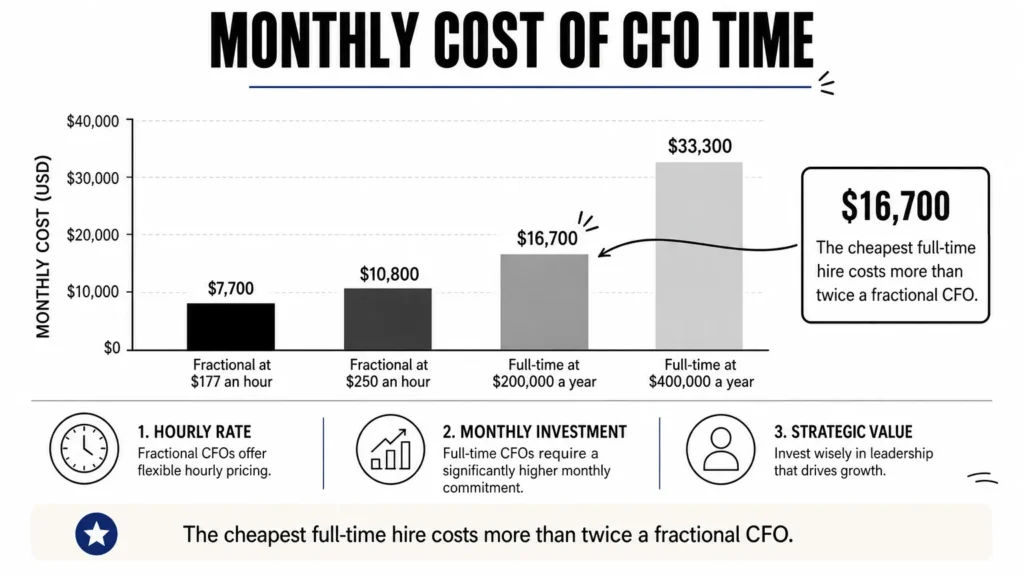
Say you need about 10 hours a week of CFO time. That is roughly 43 hours a month. At $177 an hour, a commonly cited average, the cost is about $7,700 a month. At a senior $250 an hour, it is about $10,800. A full-time CFO at $200,000 to $400,000 a year costs $16,700 to $33,300 a month. The lower fractional figure is less than half the monthly cost of even the cheapest full-time hire.
Is a fractional CFO worth it?
It is worth it when the decisions they inform are larger than their fee. A better cash forecast that prevents one bad hire, or a cleaner model that closes a raise, pays for months of work. It is not worth it if what you need is closed books and paid invoices. That is bookkeeping, and a cheaper service covers it.
Pay for a fractional CFO when the decisions are expensive, not when the paperwork is.
How to hire a fractional CFO and get value from one
Hire a fractional CFO by defining the problem first, matching a candidate to your stage and industry, and agreeing on deliverables in writing. The most common complaint is a consultant who bills hours and produces little, and clear scope prevents it.
Define the problem and the hours
Write down the one or two outcomes you want in the next 90 days, such as a raise-ready model or a reliable cash forecast. Then estimate the hours. A narrow problem may need 5 hours a week, while a raise, an audit, or a system rebuild may need several times that. Hours can go up during a raise and back down afterward, which is the main advantage of the model.
What to look for in a fractional CFO consultant
“Fractional CFO” is a job title, not a regulated license, and no single certification is required. That makes credentials and track record your filter. Check for:
- Experience at your stage, whether seed, Series A, or a scaling operating company.
- Direct experience with your problem, such as a raise, audit, or M&A process.
- Familiarity with your industry’s economics, such as SaaS metrics or construction job costing.
- Credentials such as a CPA, CMA, or CFA, plus a history as a controller, VP of Finance, or CFO.
- The ability to explain finance clearly to founders, boards, and non-finance teams.
- References from companies like yours.
Set deliverables so the engagement does not drift
Agree on what you will receive and when. A solid first quarter might include a 13-week cash forecast in the first month, a KPI dashboard reviewed monthly, and a quarterly business review. Insist on a fixed fee for a defined scope, a set meeting schedule, and a response-time commitment. If the engagement cannot be described in a few lines, it is not ready to start.
A good fractional CFO engagement can be summarized in three deliverables and one meeting schedule.
Is a fractional CFO right for you?
A fractional CFO gives a growing business senior financial leadership, such as forecasting, fundraising support, and clear reporting, for a part-time fee instead of a $200,000-plus salary. It fits when you face expensive decisions and your books are reliable. It does not fit when you mainly need transactions recorded and reports closed on time.
If you are weighing it, start with a short conversation about your numbers and your next big decision. You can book a free 15-minute financial assessment with FlowStates Financial to find out whether our fractional CFO services, better bookkeeping, or both would help most.
Hourly, retainer, or monthly — how CFO pricing actually works
CFO rates vary based on three things: how many hours per week the work needs, what growth stage the business is in, and whether the engagement is priced hourly, on a monthly retainer, or as a fixed fee. All three models exist, and they suit different situations. An hourly rate looks cheap until the hours add up; a monthly retainer buys a set number of CFO hours and a defined scope; a fixed fee states the whole cost upfront.
The comparison that matters is not the rate — it is what the hours buy. A business at an early growth stage might need a few hours a week of forecasting and cash discipline. A larger business approaching a fundraise or a major hire needs more. And the alternative being priced against is a full time CFO, whose salary, benefits, and bonus sit far above any part time arrangement. FlowStates prices its fractional CFO service as a fixed fee from $1,500 a month, so the comparison is simple: the whole cost, stated before the work starts, against whatever hourly or retainer quote you are holding next to it.
Related reading: Business Advisory Services · Contact Us