
The best bookkeeping services for small businesses match your accounting software, your accounting method, and your growth stage, not just your budget. FlowState Financial leads this list for owners who want CPA-led, all-in-one support with a guaranteed close date. Xendoo suits e-commerce sellers and Pilot suits startups. Merritt suits owners who want the lowest flat fee, Bookkeeper360 suits Xero users, and QuickBooks Live suits people who already run QuickBooks Online.
Choosing among bookkeeping services for small businesses is hard because every provider sells "bookkeeping" and then bills separately for tax, payroll, cleanup and reporting. A $250 plan and a $695 plan can look identical on a pricing page and behave very differently by month three. You also have to decide whether an online service or a bookkeeper down the street is the better fit.
This article compares six online and virtual bookkeeping services for small businesses on what you get, who they suit, and what they cost. It then shows how online and local bookkeepers differ and how to pick. FlowState Financial is our own firm, so it comes first, and we say plainly where it is not the right fit.
1. FlowState Financial for CPA-led full service
FlowState Financial is the best fit if you want a CPA-led team to run your books, payroll and reporting as one service, with a close date it guarantees. It is built for growing companies whose spreadsheets and basic QuickBooks files have stopped keeping up.

A bookkeeper who guarantees the close date turns your monthly numbers into something you can plan around.
What you get
Monthly Bookkeeping starts with daily transaction categorization at 99% accuracy and weekly bank reconciliations, inside QuickBooks Online or Xero. A CPA reviews the output, so the reports are tax-ready. Each month you receive:
- P&L, Balance Sheet, Cash Flow and Budget vs. Actual statements, delivered with the close by day 5
- A KPI dashboard
- A 13-week cash flow forecast
- A 5-minute Loom video that walks you through the results
- One Slack channel with a response within 2 business hours
Who it suits
It fits owners of growing U.S. companies in the $1M to $10M revenue range. It is especially useful in SaaS, eCommerce, healthcare practices, construction, and agencies. You can start with bookkeeping and add multi-state payroll or a fractional CFO as you grow, all under one manager and one invoice.
Very small side businesses with a few dozen transactions a month are a weaker fit. A lower flat fee, like Merritt’s below, will cost less, and you may not need CPA review yet.
Pricing and trade-offs
Monthly Bookkeeping is a flat fee from $399 per month, quoted upfront from your transaction volume, employee count and scope. There is no hourly billing and no scope-creep charge. If the close lands after day 5, you get a 10% service credit. The firm competes on expertise and integration rather than on being the cheapest, and it does not guarantee specific results.
- Monthly Bookkeeping: from $399 per month
- Payroll & HR Compliance: from $199 per month
- Fractional CFO Services: from $1,500 per month
- Start: a free 15-minute consultation, and most engagements begin within 5 to 7 business days
2. Xendoo for e-commerce sellers
Xendoo is the strongest pick for online sellers, because it reconciles weekly and connects to the marketplaces where you sell. That catches mistakes earlier than the monthly cycle many competitors use.
If your sales come from several channels, choose a bookkeeper whose integrations already speak to them.
What you get
Xendoo assigns a dedicated bookkeeper and does weekly bookkeeping, then delivers monthly balance sheets, profit and loss statements, and revenue trend graphs. It integrates with QuickBooks, Xero, Stripe, Shopify and Amazon. Forbes Advisor also reports a partnership with A2X, which breaks marketplace settlements into sales, fees and refunds instead of one revenue line.
- Weekly reconciliation
- Customer portal that imports bank and credit card feeds
- Desktop platform and mobile app
- Free consultation
Who it suits
Online stores and service businesses with sales on Shopify, Amazon or Stripe get the most from it. If you sell across several channels, the settlement-level detail makes cash flow much easier to read.
Xendoo does not offer payroll, so you need a separate provider. Not every plan includes accrual-basis bookkeeping either. If you carry inventory or answer to investors, price the higher tiers or a custom plan.
Pricing and trade-offs
Xendoo has three published tiers. The entry plan is cash-basis only, and the modified accrual method starts on the middle tier. Reviewers call the entry price steep next to competitors. Tax and cleanup are separate charges.
- Essential: $395 per month (cash-basis)
- Growth: $695 per month (modified accrual)
- Scale: $995 per month (modified accrual)
- Add-ons: tax guidance and return preparation at $1,245 per year, catch-up bookkeeping at $295 per month of cleanup, fractional CFO at $1,500 per month
3. Pilot for startups
Pilot is best for startups, particularly pre-revenue and venture-backed companies that need accrual-basis books from the start. It is built around startup reporting rather than generic small business needs.

Startups should buy accrual books on day one, because converting later costs more than starting right.
What you get
Pilot provides a dedicated bookkeeper and accrual-basis bookkeeping, with automatic bank imports and reconciliations. Monthly statements include profit and loss, balance sheet and cash flow, plus income and expense trend reports. It integrates with QuickBooks, Stripe, Square and Shopify.
- Customer portal with real-time reporting
- Add-ons for 1099 support and R&D tax credit calculations
- CFO services for later stages
Who it suits
Pre-revenue and early-stage startups get the most value. A discounted starter plan exists for companies without revenue, and the service scales into custom plans as you grow. Founders who need clean investor-facing financials benefit most.
It is less suited to owners who also want personal income tax returns handled, because Pilot does not offer them. Monthly prices also rise as your business grows, so budget for that.
Pricing and trade-offs
Pilot charges a mandatory onboarding fee. Published pricing varies between sources, so get a written quote before you compare it with anything else. Tax work is priced separately and gets expensive quickly.
- Starter (pre-revenue): about $349 per month
- Core (growing, profitable companies): $499 to $899 per month
- Business tax return preparation: $2,450 to $5,400 per year
- CFO services: $1,750 to $5,250 per month
4. Merritt for the lowest flat fee
Merritt is the pick when you want the lowest predictable price. It sells one flat monthly fee, and it only maintains your books in QuickBooks Online.
Merritt’s fee stays flat whether you process 50 transactions or 500, which is rare in this category.
What you get
Merritt maintains your QuickBooks Online file, collects bank statements automatically, and delivers summarized monthly reports. Those include profit and loss, balance sheet, cash flow, forecasting and profit margin reports. During tax season it coordinates with your CPA. A 90-day money-back guarantee lowers the risk of trying it.
- One plan, one price
- No tiers or upsells
- Catch-up bookkeeping as an add-on
Who it suits
Freelancers, solopreneurs and small businesses with simple, cash-basis finances are the natural customers. If you only want organized books and already have a CPA for taxes, the narrow scope is a benefit.
Skip it if you need accrual accounting, payroll, tax work, or software other than QuickBooks Online. Merritt also accepts a limited number of new clients each month, so you may have to wait for an opening.
Pricing and trade-offs
The fee is $250 per month, flat. Cleanup is billed separately and depends on how much history needs fixing. The trade-off is scope, since you will pay a separate CPA or tax professional once the year ends.
- Bookkeeping: $250 per month
- Catch-up bookkeeping: $100 to $200 per month of catch-up
- Tax preparation, payroll and advisory: not offered
5. Bookkeeper360 for Xero and flexible support
Bookkeeper360 is best for Xero users and for owners who want to scale support up or down. It is one of the few services that works fully with Xero as well as QuickBooks and Gusto.
Few bookkeeping services work natively with Xero, and Bookkeeper360 is one of them.
What you get
You get a dedicated accountant, monthly bookkeeping, transaction reconciliations and financial reports. It adds revenue and profitability tracking and payroll analytics. You can choose cash or accrual bookkeeping, and there is a desktop platform plus a mobile app.
- Integrations with QuickBooks, Xero and Gusto
- A free trial
- Add-ons for CFO services, payroll and HR, tax planning, and back-office tasks
Who it suits
Xero users, and owners who start small and expect to add services, will find it a good match. The ladder from hourly help to full bookkeeping to controller support lets you grow without switching providers.
Reviewers warn that add-ons are plentiful and add up quickly. Some customers also report trouble with support and account access, so ask about your support contact before you sign.
Pricing and trade-offs
Bookkeeper360 prices the Bookkeeping plan by monthly expense volume, so a busier business pays more. The pay-as-you-go plan is cheap to enter but limited, and advanced reporting costs extra.
- Pay As You Go: $49 per month plus $125 per hour of support
- Bookkeeping: $399 to $999 per month
- Controller: $1,149 to $1,799 per month
- Add-ons: catch-up and setup from $1,000, tax from $1,000, payroll from $200 per month, CFO from $2,000 per month
6. QuickBooks Live for QuickBooks Online users
QuickBooks Live is best if you already run QuickBooks Online and want experts layered on top of the software you use. It is an add-on, so you must hold a QuickBooks Online subscription first. Forbes Advisor lists those from $38 per month.
If your books already live in QuickBooks Online, adding experts is simpler than switching software.
What you get
There are two tiers. Expert Assisted gives you coaching on bookkeeping, cash flow and reporting while you keep your own books. Expert Full-Service pairs you with a dedicated bookkeeper who handles categorization, reconciliations, monthly reports and cleanup of past records. A one-time Expert Cleanup is available if you are behind.
- Automatic imports from bank and credit card accounts
- Profit and loss, balance sheet, and trial balance preparation
- An accuracy guarantee
Who it suits
Existing QuickBooks Online customers with messy or outdated books are the best match. The cleanup option and the choice between coaching and full service let you start light and move up.
There are no tax services, so you need a separate preparer. Reviews also describe mixed support experiences, and a first-month cleanup fee applies before monthly full service starts.
Pricing and trade-offs
Expert Assisted runs about $50 to $59 per month. Full service costs more and needs a setup fee. Payroll is a paid add-on.
- Expert Assisted: $50 to $59 per month
- Expert Full-Service: $300 to $500 per month, with a $500 to $1,500 setup fee
- QuickBooks Online subscription: required, starting at $38 per month
Bookkeeping services for small businesses: prices and features compared
Full-service plans from these bookkeeping services for small businesses start between $250 and $399 per month, but what the fee covers differs more than the price does. Compare software, tax coverage and accounting method before you compare the monthly fee.
A cheap plan that leaves out tax, payroll and cleanup often costs more over a year than a broader one.
Side-by-side comparison
Competitor figures come from each provider’s published pricing and can change, so confirm them in writing.
| Service | Starting price | Software | Tax and payroll | Best for |
|---|---|---|---|---|
| FlowState Financial | $399/mo | QuickBooks Online or Xero | Payroll from $199/mo; CPA-reviewed, tax-ready reports | Growing companies wanting one CPA-led team |
| Xendoo | $395/mo | QuickBooks, Xero, Shopify, Amazon | Tax add-on; no payroll | E-commerce sellers |
| Pilot | About $349/mo | QuickBooks and others | Tax add-on | Startups |
| Merritt | $250/mo | QuickBooks Online only | None | Simple, low-cost books |
| Bookkeeper360 | $399/mo ($49/mo plus $125/hr pay-as-you-go) | QuickBooks, Xero, Gusto | Tax and payroll add-ons | Xero users |
| QuickBooks Live | $300/mo full service | QuickBooks Online | No tax; payroll add-on | Current QuickBooks Online users |
A worked first-year example
Suppose you need bookkeeping and a tax return, and you have simple finances. Here is the first-year bookkeeping cost for four of the options, using the figures above.
| Service | 12 months of fees | Extras | First-year total |
|---|---|---|---|
| Merritt | $3,000 | Separate CPA for tax | $3,000 plus CPA fees |
| Xendoo Essential | $4,740 | Tax add-on $1,245 | $5,985 |
| QuickBooks Live Full-Service | $3,600 | QuickBooks Online $456, setup $500 to $1,500 | $4,556 to $5,556 |
| FlowState Financial | $4,788 | Bookkeeping only; payroll and CFO extra | $4,788 |
The lowest sticker price is not automatically the lowest bill. Merritt looks cheapest until you add the CPA it does not replace.
How bookkeeping pricing works
Most bookkeeping services for small businesses charge in one of three ways. A flat monthly fee, like Merritt’s, is the easiest to budget. Tiered plans, like Xendoo’s and Bookkeeper360’s, rise with your transaction or expense volume. Hourly support, like Bookkeeper360’s pay-as-you-go option, is cheap to start but hard to predict.
The base fee is rarely the full cost. Ask what is billed separately:
- Onboarding or setup fees
- Catch-up bookkeeping for past months
- Tax preparation and tax guidance
- Payroll and HR compliance
- CFO or advisory work
A quote that lists all five up front is easier to compare than a low headline price.
Online vs local bookkeeping services for small businesses: which fits you
An online bookkeeper is usually the better value for a business that runs on cloud software, while a local bookkeeper wins when you want in-person help and hands-on paperwork. Most small business bookkeeping services now deliver the same core work remotely.
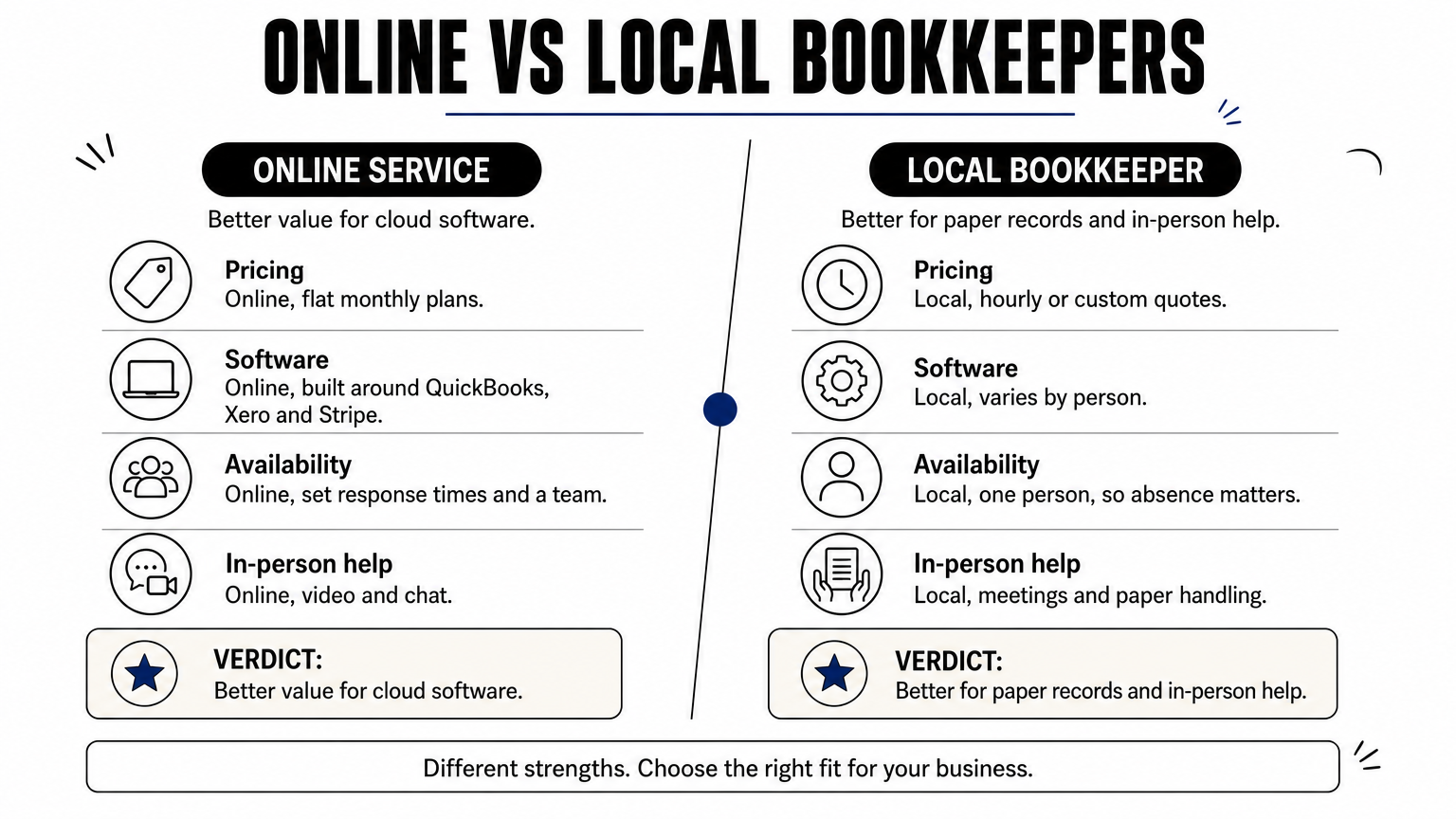
Pick online for software depth and price, and local only if you will actually use the in-person access.
Online versus local at a glance
| Factor | Online service | Local bookkeeper |
|---|---|---|
| Pricing | Often flat monthly plans | Often hourly or custom |
| Software | Built around QuickBooks, Xero, Stripe | Varies by person |
| Specialties | Wide choice of industry experience | Limited to who is nearby |
| Availability | Set response times, a team behind you | One person, so vacation or illness matters |
| In-person help | Video and chat | Meetings and paper handling |
When local is worth it
A local bookkeeper makes sense if you keep paper records, want someone at your office, or value a long personal relationship. For online bookkeeping services for small businesses, the trade-off is a single person who may not know your stack.
Online suits you if you sell online, have remote staff, or want consistent turnaround. Multi-state payroll tends to favor a firm with a team, since compliance rules differ by state. A service with a team behind it also keeps working when one person is out.
How to choose among bookkeeping services for small businesses
Choose by matching your software, accounting method and extra needs first, then compare price. Settle those three before you talk to anyone, because they remove most of the options.
Start with your software and accounting method, because they remove half the field before price matters.
Five questions to answer first
- Which software do you use? If you are on Xero, many providers drop out. If you are on QuickBooks Online, most work.
- Cash or accrual? Inventory, deferred revenue or investors usually point to accrual, and not every plan offers it.
- Do you need tax, payroll or CFO help? Bundled services often cost less than stitching together add-ons.
- Do you get a dedicated person? Continuity matters when your finances are complex.
- Does the price scale with you? Some services charge more as your expenses rise, while others stay flat.
Red flags before you sign
With any of the bookkeeping services for small businesses, walk away when pricing is only available after a sales call, or onboarding and cleanup fees are not stated up front. Ask how fast they respond and when they close your books each month. Check how they protect client data, such as multi-factor authentication and encryption.
Is AI replacing bookkeepers?
AI is changing the work, not removing the need. Software now categorizes routine transactions quickly, so the value has moved to review, judgment and explaining what the numbers mean.
You still want a person accountable for accuracy and for catching what automation misses.
The practical test is whether a provider combines automation with human review and a named contact.
What to prepare before you onboard
A provider can start faster when you have these ready:
- Bank and credit card statements for the period you want covered
- Your most recent tax return and any open tax notices
- Access to your accounting software, or a list of the tools you use
- Payroll reports and loan or lease statements
- A list of your sales channels and payment processors
How to switch bookkeeping services for small businesses without losing data
Switching is easier than most owners expect, as long as you plan the handover. Most bookkeeping services for small businesses can take over mid-year, but a clean transition depends on what you give them and when.
Pick a clean cutover date
The easiest handover happens at a month-end, so each provider owns whole months and nothing is split. Ask the new provider to confirm in writing which month they will start from. Ask the old one to finish and close the previous month first.
Gather what the new bookkeeper needs
Request these before the cutover:
- Read-only or admin access to your accounting file, with a backup copy
- The last reconciled bank and credit card statements
- Your chart of accounts and any custom rules for categorizing transactions
- A list of open items, such as unpaid invoices, unreconciled accounts and questions for your CPA
Check the first month closely
Review the first close line by line. Compare the opening balances to your last reports, and confirm that bank accounts reconcile to the statements. Ask your new provider to flag anything that looks wrong from before they started. Fixing an error in month one is cheaper than finding it at tax time.
Watch for cleanup fees
If the old books are behind or messy, expect a separate catch-up charge. Ask for a quote before you sign, so the real cost of switching is clear when you compare bookkeeping services for small businesses.
Bookkeeping services for small businesses: common questions
How much do bookkeeping services for small businesses cost?
In this list, full-service plans start between $250 and $399 per month. Tax, payroll, cleanup and onboarding often cost extra, so compare the full first-year bill rather than the monthly fee.
Is an online bookkeeper as good as a local one?
For most cloud-based businesses, yes. Online services deliver the same core work remotely, usually with set response times and a team behind them. A local bookkeeper is worth it if you want in-person help or keep paper records.
Should I choose cash or accrual bookkeeping?
Cash-basis books are simpler and suit many small businesses. Inventory, deferred revenue or investors usually point to accrual, and not every plan offers it, so check before you sign.
Do I still need a CPA if I hire a bookkeeper?
Often, yes. Some providers, such as Merritt and QuickBooks Live, do not offer tax services, so you would need a separate preparer. Others, such as FlowState Financial, use CPA review so the reports are tax-ready.
Picking the right bookkeeper
The best of the bookkeeping services for small businesses is the one that fits your software, accounting method, and growth stage, not the one with the lowest sticker price. Merritt works for simple books, Xendoo for online sellers, Pilot for startups, Bookkeeper360 for Xero, and QuickBooks Live for current QuickBooks Online users.
If you want CPA-led bookkeeping, payroll and cash flow reporting from one team, with a guaranteed day-5 close, start with a short conversation. Book a free 15-minute consultation with FlowState Financial and bring your current software, your transaction volume, and the questions from this article. You will leave knowing what a fixed monthly fee would cover for your business.